

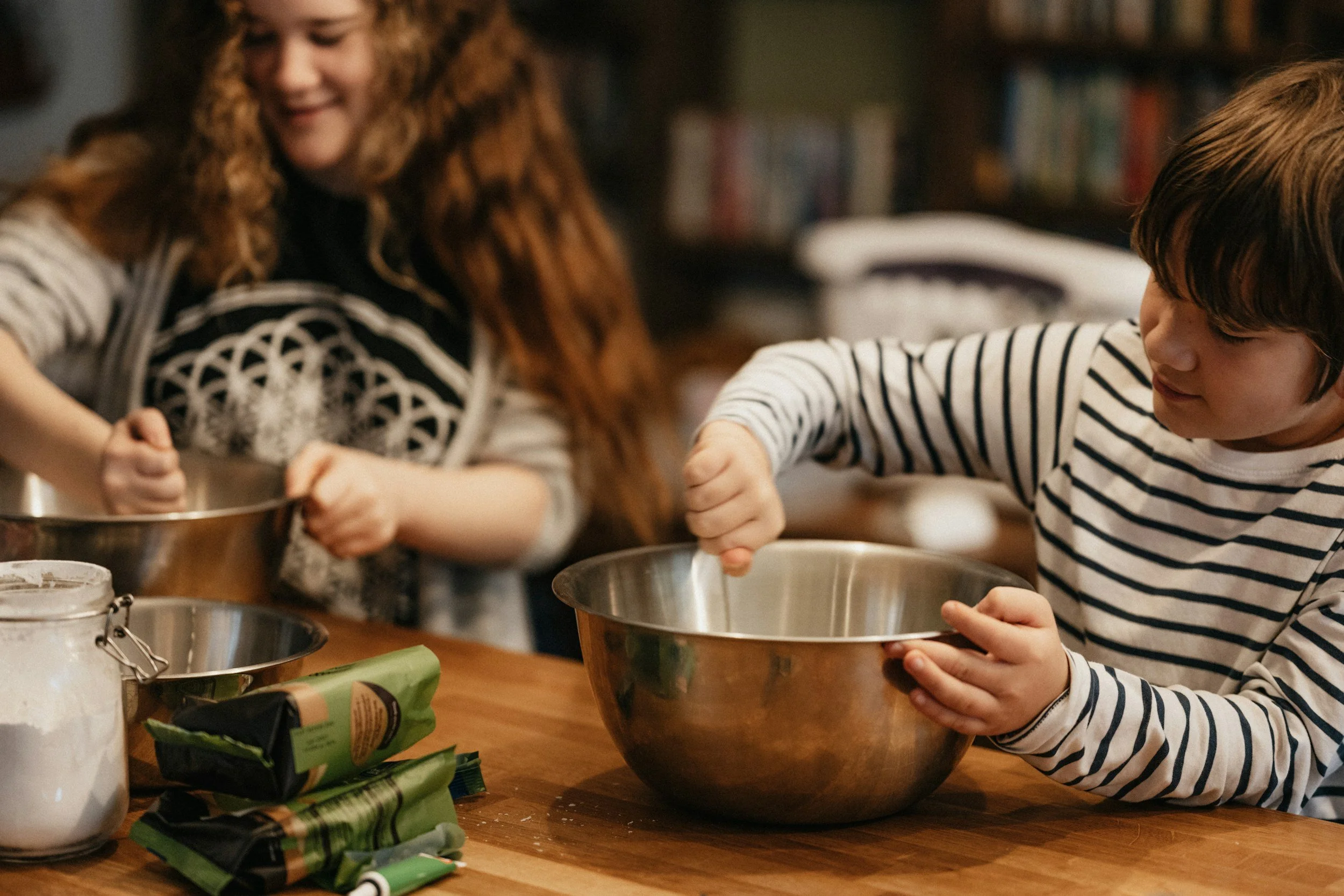
When a child helps make dinner, the result may be slower, messier, and less efficient than if an adult handled everything alone.
The measuring cup overflows. Eggshell lands in the bowl. The child stirs enthusiastically while ingredients escape onto the counter.
It may not look like a carefully planned developmental activity, but cooking naturally combines movement, sensory exploration, problem-solving, sequencing, and independence.
Most importantly, the child is not practicing an isolated skill simply because an adult said it was important. They are participating in a real family task with a visible purpose.
Real Tasks Create Natural Motivation
Children are often more willing to persist when their work contributes to something meaningful.
Scooping pretend food can be useful play. Scooping rice that the family will actually eat creates a different kind of investment. The child can see why the task matters and what their effort helped produce.
Kitchen activities also have a clear sequence:
Gather → Prepare → Combine → Cook → Serve → Clean
The child experiences how individual actions work together toward a finished result. Over time, this supports the ability to anticipate what comes next and understand that some goals require several steps.
Cooking Uses Both Hands in Different Ways
Many kitchen tasks require bilateral coordination, the ability to use both sides of the body together.
One hand may stabilize while the other performs a more precise action:
holding a bowl while stirring
steadying fruit while spreading
gripping a container while opening the lid
holding dough while cutting it
keeping a measuring cup still while pouring
stabilizing a plate while wiping it
These are the same types of coordinated roles children use when dressing, cutting with scissors, opening school supplies, and completing other daily tasks.
The kitchen also gives children opportunities to control force. Stir too gently and the ingredients do not combine. Pour too quickly and the liquid spills. Press too hard and a soft banana becomes completely flattened.
The materials provide immediate feedback without an adult needing to correct every movement.
Food Preparation Offers Sensory Information
Cooking introduces children to texture, temperature, smell, sound, resistance, and visual change.
Dough feels different before and after it is kneaded. A whole apple becomes slices. Dry ingredients change when liquid is added. Crisp vegetables make a different sound from soft fruit.
This kind of participation can be especially valuable for children who are hesitant around unfamiliar foods. Preparing food does not guarantee that a child will eat it, and tasting should not be the price of being allowed to help.
The value begins with safe exposure.
A child might tolerate being near a food, touch it with a utensil, smell it, wash it, or place it on someone else’s plate. These are meaningful forms of interaction even when eating does not happen.
Keeping preparation separate from pressure allows curiosity to develop more naturally.
Recipes Make Sequencing Visible
Cooking gives children a concrete reason to follow an order.
If the muffin tray goes into the oven before the ingredients are mixed, the final result will not work. If every ingredient is added twice, the recipe changes.
Young children can follow a short picture sequence. Older children can locate ingredients, read directions, track completed steps, or identify what needs to happen at the same time.
This involves several executive-functioning skills:
beginning a task
holding information in mind
organizing materials
following a sequence
monitoring progress
adjusting after a mistake
cleaning up at the end
Children can practice these skills without completing an abstract worksheet about organization. The structure of the activity makes organization necessary.
Mistakes Become Useful Information
Kitchen mistakes are often visible and manageable.
A child pours too much, drops something, forgets an ingredient, or realizes the selected container is too small. These moments create natural opportunities to solve problems.
Adults do not have to immediately provide the answer.
Instead, they can pause and ask:
“What do you notice?”
“What could we use instead?”
“How can we make more room?”
“What should we do before we pour?”
“Is there a way to fix it?”
Not every mistake needs to become a lesson, especially when time is limited. But when the situation is safe and the child is still engaged, allowing a moment to think can be more valuable than quickly correcting the result.
Match the Job to the Child
A child does not need to prepare an entire recipe independently to benefit from helping.
A younger child might:
wash produce
tear lettuce
transfer ingredients
stir a thick mixture
place toppings
carry napkins to the table
An older or more experienced child might:
measure ingredients
follow a short recipe
crack eggs
cut soft foods with an appropriate tool
prepare one part of a meal
load or unload safe dishwasher items
The right job is challenging enough to require attention but manageable enough for the child to remain involved.
Safety still comes first. Heat, sharp tools, food allergies, and raw ingredients require adult judgment and supervision. Independence grows through appropriate responsibility, not through removing necessary protection.
Participation Matters More Than a Perfect Result
It can be tempting to direct every movement so the recipe comes out correctly. But if the adult measures, pours, corrects, wipes, and reorganizes everything, the child may be present without truly participating.
Choose which parts need precision and which can tolerate variation.
Perhaps the adult measures the baking soda while the child measures oats. The adult handles the oven while the child sets the timer. The adult cuts firm vegetables while the child slices a banana.
Shared responsibility protects the meal while leaving meaningful work for the child.
More Than a Cooking Lesson
Helping in the kitchen can support coordination, planning, sensory exploration, communication, and confidence. It also gives children a role in family life.
They experience themselves as someone who can contribute, not simply someone who is being entertained, instructed, or cared for.
At TheraPlay LA, we value activities that connect developmental skills to real participation. A child is more likely to use a skill beyond therapy when it becomes part of everyday life.
The meal does not need to be elaborate. The child does not need to complete every step. Even washing berries, stirring batter, or setting out utensils can create a meaningful opportunity to practice independence.
The kitchen may become messier.
It may also become one of the richest learning spaces in the home.
