
Why Motor Coordination Matters: How Movement Affects Your Child’s Learning and Attention
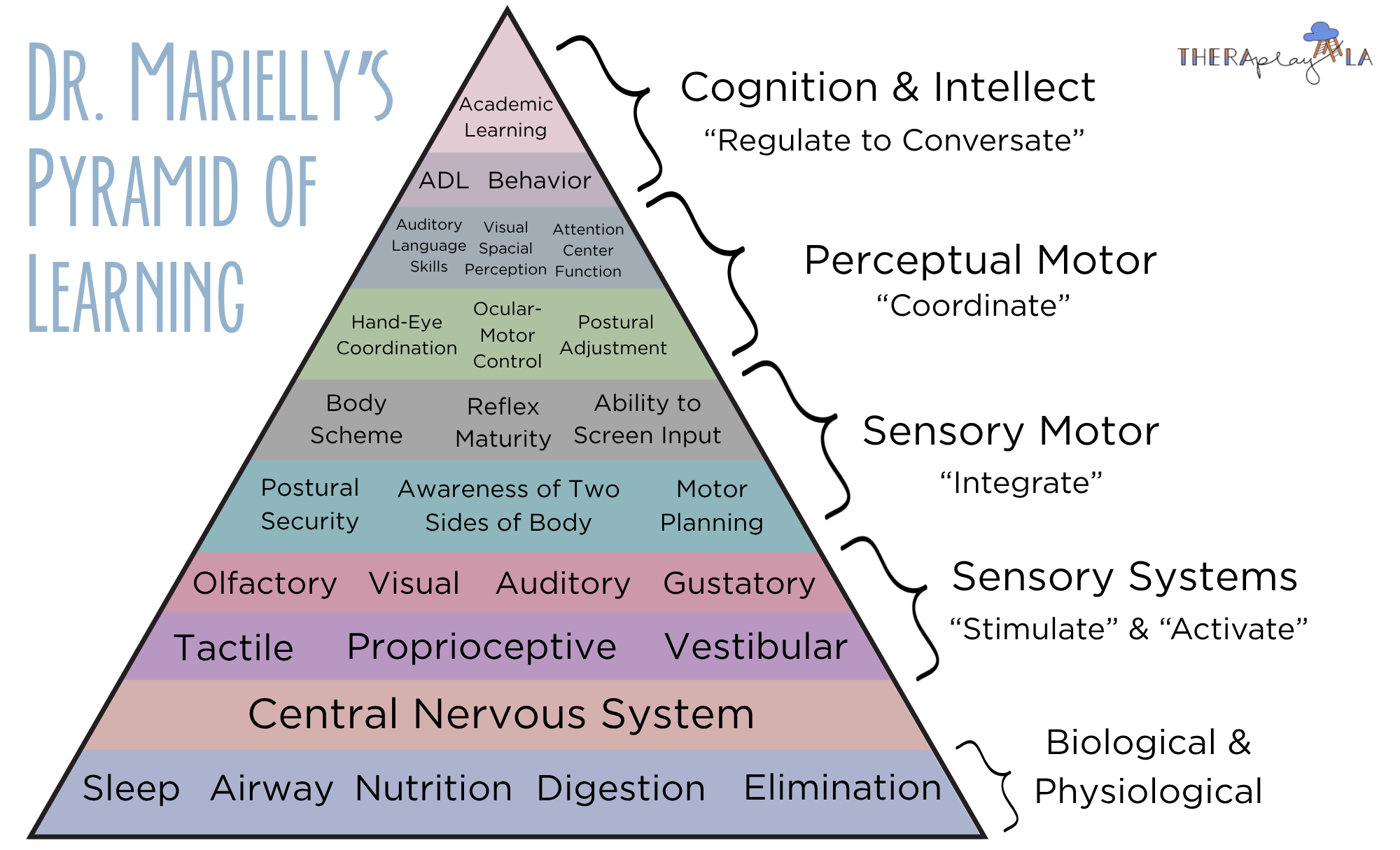
“Pyramid of Learning,” (Taylor, K. & Trott, M., 1991)
If your child struggles with attention, learning, or even speech, it’s natural to look directly at those challenges.
But what if the root isn’t where most people are looking?
What if part of the answer lives in something much earlier—and much more physical—like how your child moves their body through space?
What Is Motor Coordination (Beyond the Basics)?
When most people hear “motor coordination,” they think of sports or physical ability.
But in child development, motor coordination is far more than that.
It’s the brain’s ability to:
Receive information from the body and environment
Organize that information efficiently
Produce a purposeful, controlled response
In other words, motor coordination is real-time communication between the brain and body.
And that communication system becomes the foundation for higher-level skills like:
Attention
Problem-solving
Emotional regulation
Speech and language
The Sensory → Motor → Cognitive Connection
A helpful way to understand this is to think of development like building a house:
Sensory processing is the foundation (how the brain takes in information)
Motor coordination is the framing (how the body responds and organizes movement)
Cognitive skills are the upper levels (thinking, learning, reasoning, language)
When the foundation and framing are strong, everything built on top becomes more stable.
What this looks like in the brain:
Sensory input (touch, movement, body awareness, vision, sound)
↓
The brain integrates and organizes that input
↓
The body produces coordinated movement (motor output)
↓
The brain uses these organized patterns to support attention, planning, and learning
This is often referred to as sensorimotor integration—and it plays a critical role in how efficiently the brain develops.
Importantly, this is not a strict linear pathway. These systems are deeply interconnected and develop together over time.
Why Early Movement Patterns Matter
Early movement is not random—it’s developmental.
Skills like:
Rolling
Crawling
Reaching and grasping
Coordinating both sides of the body
…are all building the brain’s internal “wiring” for more complex tasks later on.
Take crawling, for example:
Crawling requires:
Bilateral coordination (using both sides of the body together)
Core strength and postural control
Spatial awareness
Rhythm and sequencing
These same foundational skills are later used for:
Reading (left-to-right tracking)
Writing (hand control + visual coordination)
Attention (sustaining and shifting focus)
Speech (sequencing and motor planning for sounds)
Here’s the clinically accurate way to understand it:
Early challenges with coordination (like crawling) don’t cause cognitive issues directly—but they can reflect or contribute to differences in how efficiently the brain integrates information across systems (motor, sensory, attention, and planning).
How Motor Coordination Impacts Learning, Attention, and Speech
When the brain has to work harder to coordinate the body, it often has fewer resources available for higher-level tasks.
This can show up as:
Attention & Executive Functioning
Difficulty staying focused
Trouble organizing thoughts or tasks
Becoming easily overwhelmed
Learning & Academic Skills
Struggles with handwriting
Difficulty following multi-step directions
Challenges with reading fluency
Speech & Language
Delayed articulation
Difficulty organizing thoughts into words
Challenges with expressive language
This doesn’t mean motor challenges cause these issues—but they are often part of a larger, interconnected system.
Signs Your Child May Be Struggling with Motor Coordination
Some signs are subtle and often overlooked:
Trouble sitting upright for extended periods
Tires easily with physical or academic tasks
Struggles with fine motor skills (buttons, writing, utensils)
Seems “clumsy” or uncoordinated
Avoids playground activities or physical play
Difficulty using both hands together
Difficulty imitating movements
You might also notice:
Frequent off-topic talking (difficulty organizing thoughts)
Inconsistent attention
Big reactions to small challenges (regulation difficulty)
What Actually Helps (A Root-Cause Approach)
If coordination is part of the foundation, then improving it isn’t about “pushing skills”—it’s about building the system underneath them.
At a root-cause level, effective support focuses on:
1. Sensory Integration
Helping the brain process and organize input more efficiently
2. Targeted Motor Work
Bilateral coordination
Core strength and postural control
Motor planning (praxis)
3. Nervous System Regulation
A regulated child can access coordination, attention, and learning more easily
4. Integration Across Systems
Not treating motor, sensory, and cognitive skills in isolation—but as a connected network
Moving might be the missing link
Movement is not separate from learning.
Movement is how the brain organizes itself.
When we support a child’s ability to:
Feel their body
Move with control
Coordinate both sides
Interact with their environment
…we are directly supporting how they:
Think
Focus
Communicate
Learn
Frequently Asked Questions
Does my child need to crawl to develop normally?
Not necessarily—but missing or struggling with crawling can sometimes reflect differences in coordination and integration that may be worth exploring.
Can improving motor skills help with attention?
Yes—many children show improvements in attention when underlying sensory and motor systems are better integrated.
Is this only relevant for younger children?
No—these foundational systems continue to impact older children, especially in areas like executive functioning and academic performance.
Where to Go From Here
If you’re starting to see your child differently after reading this, you’re not alone.
Many of the families we work with come in thinking the challenge is:
Attention
Behavior
Speech
…and discover there’s a deeper layer that can be supported.
If you’re curious whether this applies to your child, a discovery call can help determine if a more in-depth evaluation makes sense.
Related Resources
To go deeper, explore: